
Ranking higher on Google isn't luck. It's the result of specific, repeatable strategies applied consistently over time.
For medical practices, this matters more than ever. Patients are searching, comparing, and choosing providers online before ever picking up the phone.
The practices winning that competition aren't necessarily the most experienced or highest-rated clinically — they're often simply the most visible.
That visibility doesn't happen by accident. It's built through deliberate strategy.
This is exactly the work a Healthcare SEO Agency specializes in.
In this article, we'll walk through the specific strategies healthcare SEO experts use to help practices attract more patients, how a Digital Marketing Agency For Doctors applies these tactics in real-world settings, and why Digital Marketing for Physiotherapists requires its own tailored approach.
Strategy 1: Optimize for Local Search First
For most medical practices, local search matters more than national rankings.
Patients typically search with location-specific intent — "dentist near me," "pediatrician in [city]," or "physiotherapist downtown."
Key local SEO tactics include:
- Fully optimizing your Google Business Profile
- Ensuring consistent name, address, and phone number (NAP) across all directories
- Collecting and responding to patient reviews
- Adding location-specific service pages to your website
Local SEO often delivers the fastest, most measurable increase in new patient inquiries.
Strategy 2: Build Content Around Patient Questions
Patients frequently search for answers before searching for providers.
Questions like "why does my knee hurt when I run" or "how long does physical therapy take" represent real search demand.
A strong content strategy includes:
- Blog posts addressing common patient questions
- Condition-specific pages (e.g., "Sports Injury Treatment," "Back Pain Physiotherapy")
- Clear, accurate medical information reviewed by qualified professionals
- Natural internal links guiding readers toward booking a consultation
This type of content captures patients early in their research process — often before they've decided which provider to choose.
Strategy 3: Strengthen E-E-A-T Signals
Google places heavy emphasis on Experience, Expertise, Authoritativeness, and Trustworthiness (E-E-A-T) for health-related content.
A Healthcare SEO Agency strengthens these signals by:
- Including author bios with medical credentials
- Citing reputable medical sources
- Ensuring content is reviewed or written by licensed professionals
- Building backlinks from reputable healthcare websites
Strong E-E-A-T signals directly influence how well healthcare content ranks in search results.
Strategy 4: Improve Website User Experience
A slow, confusing, or outdated website drives potential patients away — regardless of how good your SEO is.
Key improvements typically include:
- Faster page load speeds
- Mobile-friendly design (most searches happen on phones)
- Clear navigation and simple appointment booking
- Prominent calls-to-action on every page
Better user experience doesn't just help SEO rankings — it directly increases the percentage of visitors who become actual patients.
Strategy 5: Prioritize Mobile Optimization
More than half of healthcare-related searches now happen on mobile devices.
Mobile-specific improvements include:
- Responsive design that adjusts to any screen size
- Click-to-call buttons for immediate contact
- Simplified forms for mobile users
- Fast-loading pages, even on slower connections
Practices with strong mobile experiences consistently see higher conversion rates from search traffic.
Strategy 6: Use Structured Data and Technical SEO
Behind every well-ranking healthcare website is solid technical infrastructure.
Important technical elements include:
- Schema markup that helps search engines understand medical services
- Secure, HIPAA-conscious website architecture
- Clean URL structures and organized site hierarchy
- Regular audits to fix broken links or crawl errors
These technical foundations ensure search engines can properly index and rank your website's content.
Strategy 7: Build a Strong Reputation Management System
Reviews influence both patient trust and search rankings.
An effective reputation strategy includes:
- Actively requesting reviews from satisfied patients
- Responding professionally and promptly to all feedback
- Monitoring reviews across Google, Healthgrades, and other platforms
- Using consistent messaging that reflects your practice's values
Practices with strong, consistent reviews often outperform competitors with more clinical experience but weaker online reputations.
Strategy 8: Create Specialty-Specific Landing Pages
Generic service pages rarely rank well against more targeted competitors.
Instead, effective strategies include:
- Dedicated pages for each specific condition or treatment
- Location-specific pages for practices with multiple offices
- Clear differentiation between services (e.g., separate pages for sports injury rehab vs. post-surgical physiotherapy)
This level of specificity helps search engines match your pages precisely with what patients are searching for.
Strategy 9: Leverage Video and Visual Content
Patients often prefer visual explanations over text alone, especially for treatment-related questions.
Effective visual strategies include:
- Short educational videos explaining common procedures
- Before-and-after content (where appropriate and compliant)
- Infographics simplifying complex medical information
- Patient testimonial videos
Visual content increases engagement time on your website, which positively influences search rankings.
Strategy 10: Monitor Performance and Adjust Continuously
SEO isn't a one-time project — it requires ongoing measurement and adjustment.
A Healthcare SEO Agency typically tracks:
- Keyword ranking changes over time
- Website traffic and conversion rates
- Patient acquisition costs compared to other marketing channels
- Local search visibility across multiple locations
Continuous monitoring ensures strategies stay effective as search algorithms and patient behavior evolve.
Why These Strategies Require Healthcare-Specific Expertise
General SEO strategies don't always translate directly to healthcare.
Medical practices face unique considerations:
- Strict advertising and compliance regulations
- Higher scrutiny from search engines on medical content accuracy
- Greater patient trust requirements before conversion
- More competitive, saturated local markets
A Healthcare SEO Agency applies these strategies specifically within the context of healthcare regulations and patient psychology — something general marketing agencies often overlook.
How a Digital Marketing Agency For Doctors Brings It All Together
While SEO forms the foundation, most successful practices benefit from a broader marketing approach.
A Digital Marketing Agency For Doctors typically integrates SEO with:
- Paid search advertising for immediate visibility
- Social media marketing to build community trust
- Email campaigns for patient retention and re-engagement
- Website design focused on conversion optimization
This integrated approach ensures every marketing channel reinforces the others, creating a stronger overall patient acquisition system.
Why Physiotherapists Need Tailored SEO Strategies
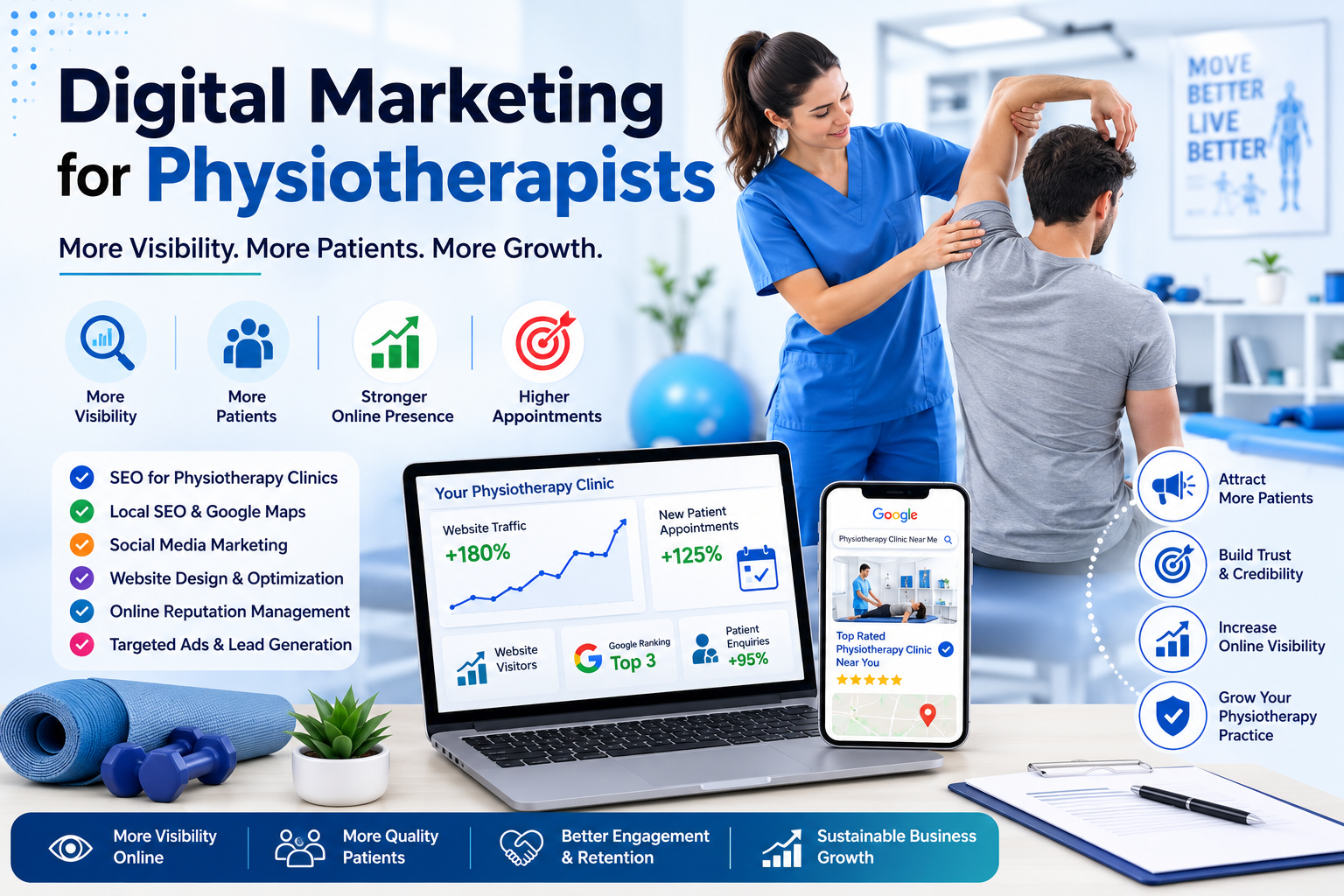
Physiotherapy clinics often compete in dense, hyper-local markets where multiple clinics serve the same small radius.
This makes precision especially important.
Digital Marketing for Physiotherapists typically emphasizes:
- Highly specific service pages (sports rehab, post-surgical recovery, chronic pain management)
- Strong local SEO tailored to neighborhood-level searches
- Patient success stories that build credibility and trust
- Review generation strategies focused on measurable patient outcomes
These tailored strategies help physiotherapy clinics differentiate themselves in ways generic healthcare SEO often misses.
Common Mistakes That Undermine Healthcare SEO Efforts
Even well-intentioned practices sometimes make mistakes that limit their SEO results.
Common pitfalls include:
- Publishing thin, generic content instead of specific, valuable information
- Ignoring negative reviews instead of addressing them professionally
- Neglecting mobile optimization
- Failing to update Google Business Profile information regularly
- Treating SEO as a one-time task rather than an ongoing strategy
Avoiding these mistakes often makes the difference between steady growth and stagnant visibility.
How to Measure Whether Your SEO Strategy Is Working
Tracking the right metrics helps determine whether your current approach is effective.
Key indicators include:
- Keyword rankings for high-intent search terms
- Organic website traffic growth over time
- Conversion rate from website visitors to booked appointments
- Number and quality of new patient reviews
- Overall cost per new patient acquired through organic search
Regularly reviewing these metrics helps practices refine their strategy and maximize return on investment.
Choosing the Right Healthcare SEO Partner
Not every agency has the expertise needed to execute these strategies effectively.
When evaluating potential partners, consider:
- Demonstrated experience specifically within healthcare SEO
- Understanding of compliance and medical advertising guidelines
- Transparent, measurable reporting
- Case studies or results from similar practices or specialties
The right partner treats SEO as a long-term growth investment, not a quick, one-time fix.
Final Thoughts
Attracting more patients today requires more than good clinical care — it requires strong, deliberate online visibility.
The strategies used by a skilled Healthcare SEO Agency — from local optimization to content development to technical improvements — work together to help practices consistently attract new patients.
Whether you're a physician seeking a specialized Digital Marketing Agency For Doctors, or a clinic exploring Digital Marketing for Physiotherapists, applying these proven strategies can meaningfully improve your practice's visibility and growth.
In a search-driven healthcare landscape, the practices that invest in strategic SEO today will be the ones patients find first tomorrow.
FAQs
1. Which SEO strategy delivers the fastest results for medical practices?
Local SEO optimization — particularly improving your Google Business Profile and local search rankings — typically delivers the fastest, most noticeable increase in new patient inquiries.
2. Why is E-E-A-T important for healthcare SEO?
Google prioritizes Experience, Expertise, Authoritativeness, and Trustworthiness heavily for health-related content. Strong E-E-A-T signals help medical content rank higher and appear more credible to both search engines and patients.
3. What makes a Digital Marketing Agency For Doctors different from a general marketing agency?
These agencies understand healthcare-specific compliance requirements, patient behavior, and content standards, allowing them to build strategies that generate results while staying within medical advertising guidelines.
4. Why does Digital Marketing for Physiotherapists require a different strategy than general healthcare SEO?
Physiotherapy clinics typically compete in smaller, hyper-local markets and rely heavily on specific treatment visibility and patient testimonials, requiring more targeted, condition-specific SEO strategies.
5. How often should healthcare SEO strategies be reviewed and updated?
SEO performance should be reviewed regularly, ideally monthly, to track keyword rankings, traffic trends, and conversion rates, allowing for ongoing adjustments as search algorithms and patient behavior evolve.